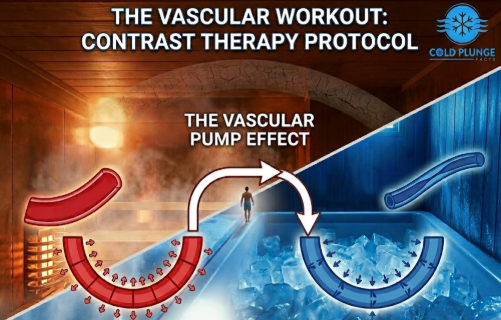
You spend hours in the gym sculpting your muscles, focusing on progressive overload to build strength and endurance. You prioritize your heart health with steady-state cardio and high-intensity interval training. But amidst all this attention on skeletal muscle and cardiac output, there is a crucial, often overlooked system that demands its own conditioning: your vascular network.
Think of your arteries and veins not just as passive pipes, but as a dynamic, living system that requires maintenance to remain functional. Just as muscles can atrophy or become tight, blood vessels can lose their elasticity over time, contributing to arterial stiffness—a hallmark of aging and cardiovascular decline. If you want to keep your “pipes” flexible and resilient, you might need to stop thinking about cardio in terms of just moving your legs and start thinking about it in terms of vascular mechanics.
I. The Anatomy of a “Vascular Workout”
At its simplest, contrast therapy is the practice of rapidly alternating between extreme heat, such as a sauna and extreme cold like an ice bath. While this might sound like a modern wellness trend, it is actually a biological “trigger” that forces your body to adapt.
Your vascular system is composed of millions of tiny vessels that are lined with smooth muscle. These muscles allow the vessels to expand (vasodilation) and contract (vasoconstriction) to control your body temperature and blood pressure. When you are sedentary, these vessels don’t get much of a “workout.” Contrast therapy provides the stimulus they crave.
- The Heat Response: When you enter a sauna (175 – 212 Fahrenheit), your body detects a rise in core temperature. The hypothalamus, your brain’s control center, signals your vessels to dilate. This pushes blood toward the surface of your skin to help you release heat through sweating and radiation.
- The Cold Response: Upon stepping into an ice-cold plunge (59 Fahrenheit), your body goes into “survival mode.” It wants to preserve your core temperature, so it triggers a massive constriction of those same vessels, shunting blood back toward your vital organs.
By cycling between these states, you are essentially performing a form of mechanical training for your vessel walls. It is a workout that happens beneath the skin, keeping your entire circulatory system responsive and capable of handling rapid changes in the environment.
II. Why Flexibility in Your Pipes Matters
As we age, our arteries naturally lose their “snap.” This is called arterial stiffness. Think of a brand-new rubber hose; it is supple and easy to bend. Now, think of a garden hose that has been left out in the sun for ten years; it’s brittle, stiff, and prone to cracking under pressure.
When your arteries become stiff, your heart has to work significantly harder to push blood throughout your body. This increases your overall blood pressure and places a constant, unnecessary load on your heart muscle.
Regular contrast therapy acts like a set of “calisthenics” for your circulatory system. By subjecting your vessels to this rhythmic expansion and contraction, you encourage the endothelium—the delicate, single-cell lining inside your blood vessels—to remain healthy and flexible. An elastic, healthy endothelium is capable of producing nitric oxide, a molecule that tells your vessels to relax and stay open, which is essential for healthy blood pressure management.
III. The Role of Hormesis in Cardiovascular Health
Why does this brief, intense stress help you? The answer lies in a biological concept called hormesis.
Hormesis describes a process where a low dose of a stressor that would be harmful at high or sustained levels actually triggers a beneficial, adaptive response in the body. If you sat in a sauna for ten hours, you would suffer from heatstroke; if you sat in an ice bath for an hour, you would face hypothermia. However, cycling between them for short bursts (3–5 minutes) is the “sweet spot” that triggers an adaptive, resilient response.
This repeated, controlled stress helps your body become better at regulating its internal environment. Over time, your body learns to handle sudden drops in temperature, shifts in heart rate, and even oxidative stress more efficiently. This isn’t just about your heart; it’s about building a robust biological system that is better equipped to handle the stresses of daily life, from extreme weather to psychological pressure.
IV. Beyond the Heart: Systemic Benefits
While arterial health is the primary benefit, the secondary effects of this “vascular workout” are significant for your overall physiology:
- Lymphatic System Activation: Your blood has the heart to pump it, but your lymphatic system—your body’s sewer and immune network—does not. It relies on muscle movement and pressure changes. The rapid shifting of blood volume caused by contrast therapy “squeezes” the lymphatic vessels, helping move lymph fluid more effectively through your tissues.
- Recovery and Waste Removal: Athletes frequently use contrast therapy because it helps “flush” metabolic waste products (like lactate) from sore tissues. By alternating heat and cold, you create a pumping effect that draws blood into an area (to provide nutrients and oxygen) and then quickly moves it out (to carry away cellular debris), accelerating the recovery process after heavy exercise.
- Neuro-Endocrine Resilience: There is a strong reason why you feel an intense, natural “high” after a cold plunge. The sudden shock triggers a massive release of norepinephrine, a neurotransmitter that promotes alertness and focus. Furthermore, it challenges your brain to override the primal “fear” response. By regularly stepping into the cold, you are training your prefrontal cortex to remain calm and focused even when your body signals discomfort.
V. How to Build Your Protocol
You do not need to be an elite athlete to see the benefits. In fact, a conservative approach is often the most effective for long-term health.
- The Ratio: A classic starting point is a 3:1 ratio. Spend 3 minutes in the heat (sauna) followed by 1 minute in the cold (plunge).
- The Cycle: Aim for 3 to 4 rounds. This is enough to get your heart rate up and down several times without causing excessive fatigue.
- The Finish: Most practitioners recommend ending on a cold cycle. This helps reduce inflammation, prevent overheating after you leave the session, and generally leave you feeling more alert and refreshed.
- Adaptation: Start with “cool” water rather than freezing ice water. Your goal is to get your blood vessels to move, not to see how much you can shiver. As you get more comfortable over the weeks, you can slowly decrease the temperature.
VI. Safety: The Foundation of Success
Because you are intentionally stressing your cardiovascular system, you must be responsible. This is not a “no pain, no gain” situation.
- Medical Consultation: If you have high blood pressure, a history of heart issues, arrhythmias, or if you are pregnant, you must talk to your doctor first. Your doctor can help you determine if this practice is safe for your individual health profile.
- Stay Hydrated: You will lose significant fluids during the sauna phase. Make sure you are drinking water with electrolytes (not just plain water) before and after your session to prevent cardiovascular strain.
- The Breathing Rule: Do not hold your breath in the cold. It’s an instinct, but it can trigger the “Valsalva maneuver,” which drastically spikes your blood pressure and increases the risk of fainting. Force yourself to take long, slow, controlled exhales. This signals to your nervous system that you are safe, keeping your heart rate manageable.
- Watch for Symptoms: If you feel lightheaded, dizzy, or notice chest pain, stop immediately. Never “tough it out.” If you feel like you are going to faint, sit or lie down on the floor immediately.
By adding contrast therapy to your wellness routine, you aren’t just training for today. You’re conditioning your body for a healthier, more elastic tomorrow. You are teaching your cardiovascular system to be more responsive, resilient, and youthful.