

Not All Fat Is Created Equal
In the cultural war against obesity, the word “fat” has become synonymous with “bad.” We are taught that adipose tissue is merely a storage depot for excess calories—a passive backpack of energy we carry around the waist.
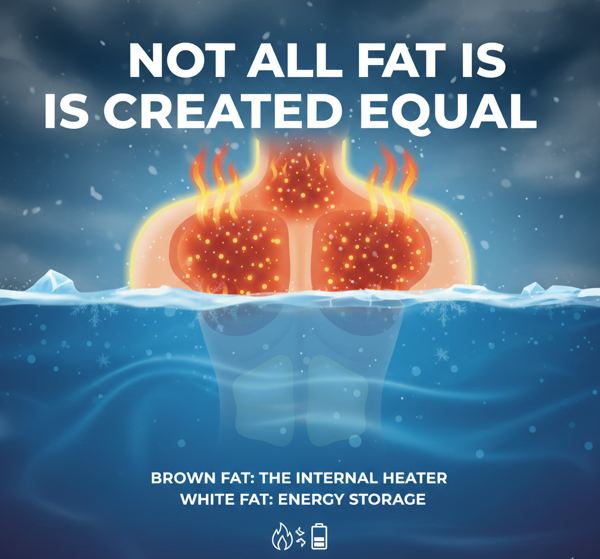
However, this view ignores a critical biological distinction. You actually possess two distinct types of adipose tissue. There is White Adipose Tissue (WAT), the energy storage system we all know. But hiding in your upper back, neck, and shoulders is a second, metabolically active type: Brown Adipose Tissue (BAT).
BAT is not a storage unit; it is a heater. It evolved to keep mammals alive in freezing conditions by burning glucose to generate heat. The problem? Modern life—with its heated cars, climate-controlled offices, and warm beds—has put this ancient furnace to sleep.
The Biological Problem: The “Thermoneutral” Trap
To understand why BAT goes dormant, we must look at our environment. Most modern humans spend 99% of their lives in the “Thermoneutral Zone”—the temperature range (roughly 64°F to 75°F) where the body doesn’t need to expend energy to maintain its core temperature.
In this zone, Brown Fat is metabolically unnecessary. Like a muscle that is never used, it atrophies. In many adults, BAT is almost undetectable, leaving them with a slower metabolism and poor glucose control. The goal of cold exposure is not just to “burn calories” in the moment, but to recruit and reactivate this dormant tissue permanently.
Mechanism I: The Mitochondrial Difference
Why is it brown? The distinct color comes from an incredibly high density of iron-rich mitochondria—the power plants of the cell.
While white fat cells contain a single large lipid droplet (grease) and very few mitochondria, brown fat cells are packed with smaller lipid droplets and thousands of mitochondria. This structural difference dictates their function:
- White Fat: Stores energy for later.
- Brown Fat: Burns energy now.
Mechanism II: Uncoupling Protein 1 (The “Engine Rev”)
The true magic of BAT lies in a specific protein called UCP1 (Uncoupling Protein 1). In a normal cell, mitochondria turn fuel (glucose/fat) into ATP (usable energy). UCP1 “uncouples” this process. It short-circuits the mitochondrial grid.
The Analogy: Imagine a car sitting in a driveway.
- Normal Metabolism: The engine runs to turn the wheels (creating movement/ATP).
- Brown Fat Metabolism: You put the car in “Neutral” and stomp on the gas pedal. The engine revs, fuel is being consumed rapidly, but the car doesn’t move. Instead, the engine gets incredibly hot. This is Non-Shivering Thermogenesis. Your body is burning fuel strictly to create heat.
Mechanism III: The Glucose Sink
Because BAT requires massive amounts of fuel to generate this heat, it acts as a “glucose sink.”
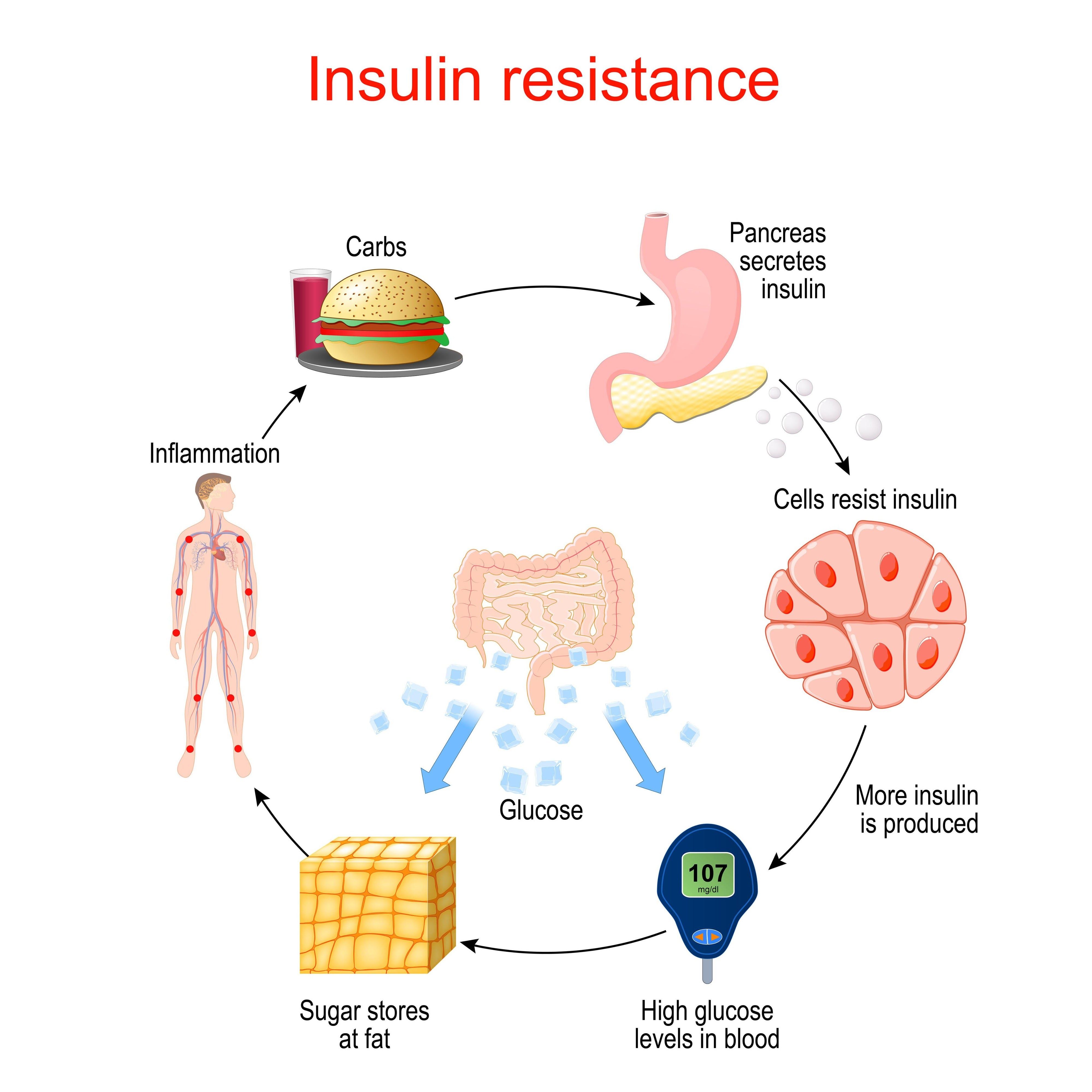
When activated by cold, BAT sucks glucose and triglycerides out of the bloodstream at an accelerated rate. This improves insulin sensitivity and helps manage blood sugar levels, making it a powerful tool not just for weight management but for metabolic longevity.
The Evidence: The “Winter Swimmer” Study
The most compelling evidence comes from the recent “Søberg Study” (Cell Reports Medicine, 2021). Researchers compared winter swimmers (who adapted to cold) with a control group.
- The Finding: The winter swimmers had significantly higher BAT activity and better thermoregulation.
- The Caloric Impact: While the calories burned during the plunge are modest, the metabolic flexibility gained is profound. The swimmers could burn fat more efficiently at rest because their “furnace” was pilot-lit and ready to roar.
The Protocol: How to Recruit Brown Fat
Reactivating BAT is a training process. It requires consistent exposure to temperatures that signal to the body: “We need more heat.”
- The Target Zone: You do not need freezing water to activate BAT. Research suggests activation begins around 66°F (19°C) in air, or slightly warmer in water due to thermal conductivity. However, 50°F–60°F is the sweet spot for efficiency.
- The “Shiver” Threshold: To maximize the recruit of BAT, you want to get cold enough to almost shiver.
- Recent research nuance: While shivering releases succinate (which activates BAT), the ultimate goal of adaptation is to develop enough BAT that you stop shivering. You want to reach a point where you can sit in cold water and generate heat internally without muscle spasms.
- Target Area: Submerge the neck and upper spine. This is where the highest concentration of BAT depots is located in adults.
The Takeaway
Brown fat is a metabolic superpower that is currently sleeping in your upper back. It is the biological difference between a body that stores excess energy and a body that burns it. Cold water is simply the wake-up call it has been waiting for.
Sources & Further Reading
- Søberg, S., et al. (2021). Altered brown fat thermoregulation and enhanced cold-induced thermogenesis in young, healthy, winter-swimming men. Cell Reports Medicine.
- Cannon, B., & Nedergaard, J. (2004). Brown adipose tissue: function and physiological significance. Physiological Reviews.
- Leitner, B. P., et al. (2017). Mapping of human brown adipose tissue in lean and obese young men. PNAS.